


Page 456 - NIXBOOK
P. 456
see when Kilo would start to pick up the scent and change his behavior to indicate he was homing in on the odor source.  So the
        state certifying officials picked up on those principals years ago, they developed stringent car testing protocols developed into a
        “double-blind” test where no instructors at all would be present for the car searching; it was just the handler and the dog. That
        way there was no chance that the dog or handler would get any kind of clues about what or where to focus their searching. So
        when the dogs alerted to certain cars, we’d note which cars and which parts of the cars, and then submit paperwork to the
        scoring officials later; the ones who knew where the drugs had been hidden. That test was actually the easiest; the fact that there
        was nobody else watching with a critical or curious eye actually relieved a lot of pressure.

        When I started studying for our first state certification test, I was a little alarmed to see that the requirements included some
        basic obedience commands and skills that Kilo didn’t have; like being able to walk next to me in a very controlled manner, and
        being able to sit and lay down and things like that. When I mentioned this to the state official he relaxed me right away. “Those
        rules were written for patrol dogs, not drug dogs!” He explained. “Patrol dogs, hell yeah you need those under complete control.
        You need to be able to call them off anybody at any time, even if they are starting or in complete attack mode.” That makes
        sense, I agreed. “But drug dogs are different,” he continued. “If a drug dog is pulling pulling pulling hard on a leash to get into
        an area to be searched, that’s not a problem! He’s not going to go attack anybody, he’s going to find the drugs so he can play! I
        don’t want to see a drug dog handler holding that dog back!”  I was then assured that the obedience requirements part of the
        testing process was not required anymore. The Border Patrol agent/state official told me “My philosophy is…if the dog can enter
        the area to be searched and not bite anybody, find the drugs, and leave without biting anybody, then the dog passes, no matter
        how big a spaz he may be.”

        The point was further emphasized when another handler, during a test, restrained his dog too much while looking for hidden
        drugs. The instructors told him afterward “Well you did great, almost. You found all of the hidden drugs, but you don’t get a
        perfect score because we hid an extra one just outside the search area, which your dog totally could smell and was trying to drag
        you over to it repeatedly, but you kept pulling him away!”
        After Kilo and I got our 200 hours of training time in, we qualified to take the
        certification test. It was stressful for me, but we passed and I was super happy. A
        year later we did it again. Also stressful, but very happy afterward. Not every K9
        unit passed it on the first try; sometimes for whatever reason some dogs would miss
        some drugs, usually because the handlers neglected to notice that the dogs had
        missed some part of a room or a car. That the was main purpose of the handler,
        really; to ensure their dogs got every corner and every area of the place or thing to
        be searched. Sometimes the drug odors would get airborne and spread out and be
        easy  for  the  dogs  to  zoom  in  on;  but  sometimes  the  drug  odors  would  be  very
        minimal and not spread out, or even worse there would be an air current that was
        carrying away the drug odor so effectively that the dog could be within a foot of the source and not smell it because the odor
        was literally not present in the air where the dog’s nose is. Again, that’s why the human handler is there; to make sure the dog
        gets into every place it should to find the drugs.

        After we got certified as an official state-approved K9 team, I continued to train with other K9 units. The best training was in
        Seattle with K9 units from larger agencies. They had access to all kinds of interesting places, and once a month they’d host a
        training where anywhere from 6 to 12 other teams would show up. Drugs would be hidden, and we’d take turns finding them.

        One time the training location was at a Seattle public works yard; where there were dozens of trucks, bulldozers and cars and
        sheds of all kinds. One of the instructors hid some drugs in the bucket part of a boom truck; literally about 12 feet off the ground.
        Most of the dogs were able to catch the scent in the wind; it was the job of the handlers to note their dogs’ changes of behavior
        and help guide them into the area closest to the source, which in that case was about 25 feet downwind of the truck’s bucket.
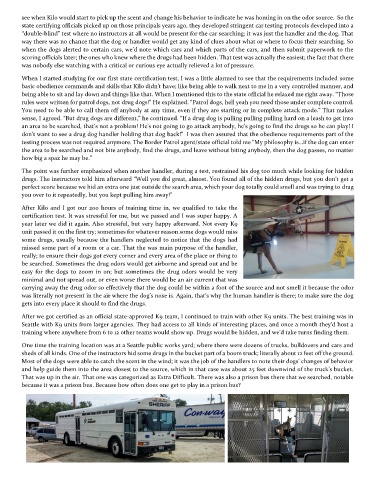
        That was up in the air. That one was categorized as Extra Difficult. There was also a prison bus there that we searched, notable
        because it was a prison bus. Because how often does one get to play in a prison bus?

