


Page 451 - NIXBOOK
P. 451
A lot of the confusion is because different dog breeds do things differently and generally speaking, one cannot classify “a dog”
        as having typical behaviors, reactions, and thought processes as any other random dog. And within each breed, of course each
        individual dog has its own personality and way of doing things. What motivates one dog may not work for other dogs, even its
        own littermates that had the exact same upbringing and training. So while one trainer may say “always” and another says “never”,
        it doesn’t mean they are wrong; ultimately it depends on the handler trying out different things and having the options to figure
        out which methods and technique work best for the combination that is the “K-9 Unit” (or “Team”) – that being of course the
        handler and the dog working together.

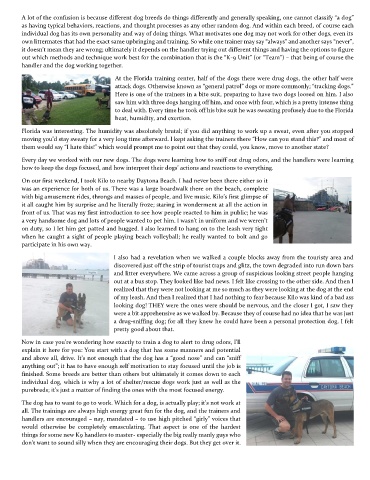
                                       At the Florida training center, half of the dogs there were drug dogs, the other half were
                                       attack dogs. Otherwise known as “general patrol” dogs or more commonly; “tracking dogs.”
                                       Here is one of the trainers in a bite suit, preparing to have two dogs loosed on him. I also
                                       saw him with three dogs hanging off him, and once with four, which is a pretty intense thing
                                       to deal with. Every time he took off his bite suit he was sweating profusely due to the Florida
                                       heat, humidity, and exertion.
        Florida was interesting. The humidity was absolutely brutal; if you did anything to work up a sweat, even after you stopped
        moving you’d stay sweaty for a very long time afterward. I kept asking the trainers there “How can you stand this?” and most of
        them would say “I hate this!” which would prompt me to point out that they could, you know, move to another state?
        Every day we worked with our new dogs. The dogs were learning how to sniff out drug odors, and the handlers were learning
        how to keep the dogs focused, and how interpret their dogs’ actions and reactions to everything.

        On our first weekend, I took Kilo to nearby Daytona Beach. I had never been there either so it
        was an experience for both of us. There was a large boardwalk there on the beach, complete
        with big amusement rides, throngs and masses of people, and live music. Kilo’s first glimpse of
        it all caught him by surprise and he literally froze; staring in wonderment at all the action in
        front of us. That was my first introduction to see how people reacted to him in public; he was
        a very handsome dog and lots of people wanted to pet him. I wasn’t in uniform and we weren’t
        on duty, so I let him get patted and hugged. I also learned to hang on to the leash very tight
        when he caught a sight of people playing beach volleyball; he really wanted to bolt and go
        participate in his own way.
                                       I also had a revelation when we walked a couple blocks away from the touristy area and
                                       discovered just off the strip of tourist traps and glitz, the town degraded into run down bars
                                       and litter everywhere. We came across a group of suspicious looking street people hanging
                                       out at a bus stop. They looked like bad news. I felt like crossing to the other side. And then I
                                       realized that they were not looking at me so much as they were looking at the dog at the end
                                       of my leash. And then I realized that I had nothing to fear because Kilo was kind of a bad ass
                                       looking dog! THEY were the ones were should be nervous, and the closer I got, I saw they
                                       were a bit apprehensive as we walked by. Because they of course had no idea that he was just
                                       a drug-sniffing dog; for all they knew he could have been a personal protection dog. I felt
                                       pretty good about that.

        Now in case you’re wondering how exactly to train a dog to alert to drug odors, I’ll
        explain it here for you: You start with a dog that has some manners and potential
        and above all, drive. It’s not enough that the dog has a “good nose” and can “sniff
        anything out”; it has to have enough self motivation to stay focused until the job is
        finished. Some breeds are better than others but ultimately it comes down to each
        individual dog, which is why a lot of shelter/rescue dogs work just as well as the
        purebreds; it’s just a matter of finding the ones with the most focused energy.
        The dog has to want to go to work. Which for a dog, is actually play; it’s not work at
        all. The trainings are always high energy great fun for the dog, and the trainers and
        handlers are encouraged – nay, mandated – to use high pitched “girly” voices that
        would  otherwise  be  completely  emasculating.  That  aspect  is  one  of  the  hardest
        things for some new K9 handlers to master- especially the big really manly guys who
        don’t want to sound silly when they are encouraging their dogs. But they get over it.

