


Page 452 - NIXBOOK
P. 452
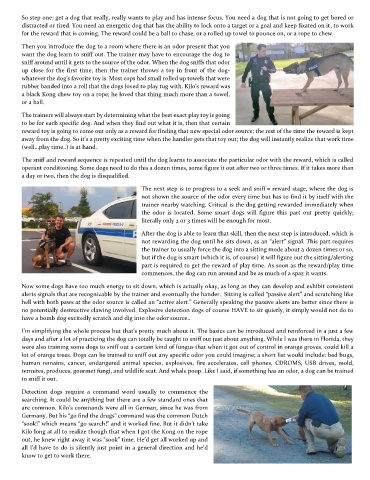
So step one: get a dog that really, really wants to play and has intense focus. You need a dog that is not going to get bored or
        distracted or tired. You need an energetic dog that has the ability to lock onto a target or a goal and keep fixated on it, to work
        for the reward that is coming. The reward could be a ball to chase, or a rolled up towel to pounce on, or a rope to chew.

        Then you introduce the dog to a room where there is an odor present that you
        want the dog learn to sniff out. The trainer may have to encourage the dog to
        sniff around until it gets to the source of the odor. When the dog sniffs that odor
        up close for the first time, then the trainer throws a toy in front of the dog-
        whatever the dog’s favorite toy is. Most cops had small rolled up towels that were
        rubber banded into a roll that the dogs loved to play tug with. Kilo’s reward was
        a black Kong chew toy on a rope; he loved that thing much more than a towel,
        or a ball.

        The trainers will always start by determining what the best exact play toy is going
        to be for each specific dog. And when they find out what it is, then that certain
        reward toy is going to come out only as a reward for finding that new special odor source; the rest of the time the reward is kept
        away from the dog. So it’s a pretty exciting time when the handler gets that toy out; the dog will instantly realize that work time
        (well…play time..) is at hand.
        The sniff and reward sequence is repeated until the dog learns to associate the particular odor with the reward, which is called
        operant conditioning. Some dogs need to do this a dozen times, some figure it out after two or three times. If it takes more than
        a day or two, then the dog is disqualified.
                                                The next step is to progress to a seek and sniff = reward stage, where the dog is
                                                not shown the source of the odor every time but has to find it by itself with the
                                                trainer nearby watching. Critical is the dog getting rewarded immediately when
                                                the  odor  is  located.  Some  smart  dogs  will  figure  this  part  out  pretty  quickly;
                                                literally only 2 or 3 times will be enough for most.

                                                After the dog is able to learn that skill, then the next step is introduced, which is
                                                not rewarding the dog until he sits down, as an “alert” signal. This part requires
                                                the trainer to usually force the dog into a sitting mode about a dozen times or so,
                                                but if the dog is smart (which it is, of course) it will figure out the sitting/alerting
                                                part is required to get the reward of play time. As soon as the reward/play time
                                                commences, the dog can run around and be as much of a spaz it wants.
        Now some dogs have too much energy to sit down, which is actually okay, as long as they can develop and exhibit consistent
        alerts signals that are recognizable by the trainer and eventually the hander.  Sitting is called “passive alert” and scratching like
        hell with both paws at the odor source is called an “active alert.” Generally speaking the passive alerts are better since there is
        no potentially destructive clawing involved. Explosive detection dogs of course HAVE to sit quietly, it simply would not do to
        have a bomb dog excitedly scratch and dig into the odor source..

        I’m simplifying the whole process but that’s pretty much about it. The basics can be introduced and reinforced in a just a few
        days and after a lot of practicing the dog can totally be taught to sniff out just about anything. While I was there in Florida, they
        were also training some dogs to sniff out a certain kind of fungus that when it got out of control in orange groves, could kill a
        lot of orange trees. Dogs can be trained to sniff out any specific odor you could imagine; a short list would include: bed bugs,
        human  remains,  cancer,  endangered  animal  species,  explosives,  fire  accelerates,  cell  phones,  CDROMS,  USB  drives,  mold,
        termites, produces, gourmet fungi, and wildlife scat. And whale poop. Like I said, if something has an odor, a dog can be trained
        to sniff it out.
        Detection  dogs  require  a  command  word  usually  to  commence  the
        searching. It could be anything but there are a few standard ones that
        are common. Kilo’s commands were all in German, since he was from
        Germany. But his “go find the drugs” command was the common Dutch
        “sook!” which means “go search!” and it worked fine. But it didn’t take
        Kilo long at all to realize though that when I got the Kong on the rope
        out, he knew right away it was “sook” time. He’d get all worked up and
        all I’d have to do is silently just point in a general direction and he’d
        know to get to work there.

