


Page 454 - NIXBOOK
P. 454
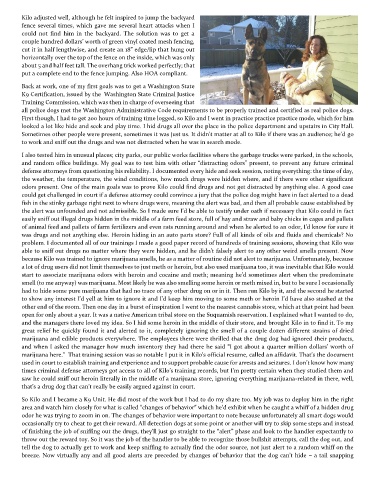
Kilo adjusted well, although he felt inspired to jump the backyard
        fence several times, which gave me several heart attacks when I
        could  not  find  him  in  the  backyard.  The  solution  was  to  get  a
        couple hundred dollars’ worth of green vinyl coated mesh fencing,
        cut it in half lengthwise, and create an 18” edge/lip that hung out
        horizontally over the top of the fence on the inside, which was only
        about 5 and half feet tall. The overhang trick worked perfectly; that
        put a complete end to the fence jumping. Also HOA compliant.
        Back at work, one of my first goals was to get a Washington State
        K9 Certification, issued by the  Washington State Criminal Justice
        Training Commission, which was then in charge of overseeing that
        all police dogs met the Washington Administrative Code requirements to be properly trained and certified as real police dogs.
        First though, I had to get 200 hours of training time logged, so Kilo and I went in practice practice practice mode, which for him
        looked a lot like hide and seek and play time. I hid drugs all over the place in the police department and upstairs in City Hall.
        Sometimes other people were present, sometimes it was just us. It didn’t matter at all to Kilo if there was an audience; he’d go
        to work and sniff out the drugs and was not distracted when he was in search mode.
        I also tested him in unusual places; city parks, our public works facilities where the garbage trucks were parked, in the schools,
        and random office buildings. My goal was to test him with other “distracting odors” present, to prevent any future criminal
        defense attorneys from questioning his reliability. I documented every hide and seek session, noting everything: the time of day,
        the weather, the temperature, the wind conditions, how much drugs were hidden where, and if there were other significant
        odors present. One of the main goals was to prove Kilo could find drugs and not get distracted by anything else. A good case
        could get challenged in court if a defense attorney could convince a jury that the police dog might have in fact alerted to a dead
        fish in the stinky garbage right next to where drugs were, meaning the alert was bad, and then all probable cause established by
        the alert was unfounded and not admissible. So I made sure I’d be able to testify under oath if necessary that Kilo could in fact
        easily sniff out illegal drugs hidden in the middle of a farm feed store, full of hay and straw and baby chicks in cages and pallets
        of animal feed and pallets of farm fertilizers and even rats running around and when he alerted to an odor, I’d know for sure it
        was drugs and not anything else. Heroin hiding in an auto parts store? Full of all kinds of oils and fluids and chemicals? No
        problem. I documented all of our trainings I made a good paper record of hundreds of training sessions, showing that Kilo was
        able to sniff out drugs no matter where they were hidden, and he didn’t falsely alert to any other weird smells present. Now
        because Kilo was trained to ignore marijuana smells, he as a matter of routine did not alert to marijuana. Unfortunately, because
        a lot of drug users did not limit themselves to just meth or heroin, but also used marijuana too, it was inevitable that Kilo would
        start to associate marijuana odors with heroin and cocaine and meth; meaning he’d sometimes alert when the predominate
        smell (to me anyway) was marijuana. Most likely he was also smelling some heroin or meth mixed in, but to be sure I occasionally
        had to hide some pure marijuana that had no trace of any other drug on or in it. Then run Kilo by it, and the second he started
        to show any interest I’d yell at him to ignore it and I’d keep him moving to some meth or heroin I’d have also stashed at the
        other end of the room. Then one day in a burst of inspiration I went to the nearest cannabis store, which at that point had been
        open for only about a year. It was a native American tribal store on the Suquamish reservation. I explained what I wanted to do,
        and the managers there loved my idea. So I hid some heroin in the middle of their store, and brought Kilo in to find it. To my
        great relief he quickly found it and alerted to it, completely ignoring the smell of a couple dozen different strains of dried
        marijuana and edible products everywhere. The employees there were thrilled that the drug dog had ignored their products,
        and when I asked the manager how much inventory they had there he said “I got about a quarter million dollars’ worth of
        marijuana here.”  That training session was so notable I put it in Kilo’s official resume, called an affidavit. That’s the document
        used in court to establish training and experience and to support probable cause for arrests and seizures. I don’t know how many
        times criminal defense attorneys got access to all of Kilo’s training records, but I’m pretty certain when they studied them and
        saw he could sniff out heroin literally in the middle of a marijuana store, ignoring everything marijuana-related in there, well,
        that’s a drug dog that can’t really be easily argued against in court.

        So Kilo and I became a K9 Unit. He did most of the work but I had to do my share too. My job was to deploy him in the right
        area and watch him closely for what is called “changes of behavior” which he’d exhibit when he caught a whiff of a hidden drug
        odor he was trying to zoom in on. The changes of behavior were important to note because unfortunately all smart dogs would
        occasionally try to cheat to get their reward. All detection dogs at some point or another will try to skip some steps and instead
        of finishing the job of sniffing out the drugs, they’ll just go straight to the “alert” phase and look to the handler expectantly to
        throw out the reward toy. So it was the job of the handler to be able to recognize those bullshit attempts, call the dog out, and
        tell the dog to actually get to work and keep sniffing to actually find the odor source, not just alert to a random whiff on the
        breeze. Now virtually any and all good alerts are preceded by changes of behavior that the dog can’t hide  – a tail snapping

