


Page 350 - NIXBOOK
P. 350
Of course the Poulsbo Police Department never got one of those things. And we had only
        one bullet proof riot shield, which we hardly ever used.
        Like I said, a lot of (ignorant) citizens were horrified at the “militarization” of police. Sure,
        a  police  sniper  or  two  for  larger  departments  would  be  a  good  idea,  and  maybe  some
        tactical wheeled or tracked robots for taking care of bombs, but helmets on police officers!
        My heavens no! Assault rifles out in public? Oh dear! But slowly, general attitudes really
        started to change after September 11th 2001, when police departments everywhere had to
        take on new and increased security roles. After the initial shock of seeing helmeted cops
        holding large rifles at airports and large sporting events at stadiums, people gradually got
        used to the new look, especially after a couple more decades of really bad mass shooting in
        schools and malls. And stores and festivals. And concerts. And churches. And playgrounds.

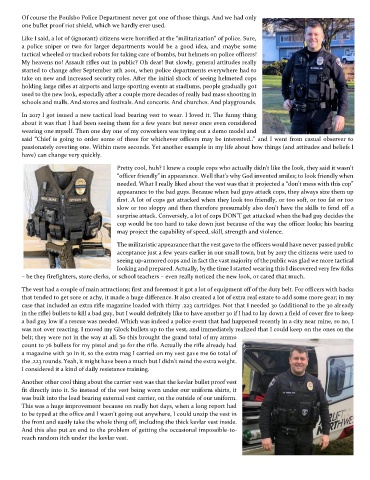
        In 2017 I got issued a new tactical load bearing vest to wear. I loved it. The funny thing
        about it was that I had been seeing them for a few years but never once even considered
        wearing one myself. Then one day one of my coworkers was trying out a demo model and
        said “Chief is going to order some of these for whichever officers may be interested..” and I went from casual observer to
        passionately coveting one. Within mere seconds. Yet another example in my life about how things (and attitudes and beliefs I
        have) can change very quickly.

                                        Pretty cool, huh? I knew a couple cops who actually didn’t like the look, they said it wasn’t
                                        “officer friendly” in appearance. Well that’s why God invented smiles; to look friendly when
                                        needed. What I really liked about the vest was that it projected a “don’t mess with this cop”
                                        appearance to the bad guys. Because when bad guys attack cops, they always size them up
                                        first. A lot of cops get attacked when they look too friendly, or too soft, or too fat or too
                                        slow or too sloppy and then therefore presumably also don’t have the skills to fend off a
                                        surprise attack. Conversely, a lot of cops DON’T get attacked when the bad guy decides the
                                        cop would be too hard to take down just because of the way the officer looks; his bearing
                                        may project the capability of speed, skill, strength and violence.

                                        The militaristic appearance that the vest gave to the officers would have never passed public
                                        acceptance just a few years earlier in our small town, but by 2017 the citizens were used to
                                        seeing up-armored cops and in fact the vast majority of the public was glad we more tactical
                                        looking and prepared. Actually, by the time I started wearing this I discovered very few folks
        – be they firefighters, store clerks, or school teachers – even really noticed the new look, or cared that much.

        The vest had a couple of main attractions; first and foremost it got a lot of equipment off of the duty belt. For officers with backs
        that tended to get sore or achy, it made a huge difference. It also created a lot of extra real estate to add some more gear; in my
        case that included an extra rifle magazine loaded with thirty .223 cartridges. Not that I needed 30 (additional to the 30 already
        in the rifle) bullets to kill a bad guy, but I would definitely like to have another 30 if I had to lay down a field of cover fire to keep
        a bad guy low if a rescue was needed. Which was indeed a police event that had happened recently in a city near mine, so no, I
        was not over reacting. I moved my Glock bullets up to the vest, and immediately realized that I could keep on the ones on the
        belt; they were not in the way at all. So this brought the grand total of my ammo
        count to 76 bullets for my pistol and 30 for the rifle. Actually the rifle already had
        a magazine with 30 in it, so the extra mag I carried on my vest gave me 60 total of
        the .223 rounds. Yeah, it might have been a much but I didn’t mind the extra weight.
        I considered it a kind of daily resistance training.
        Another other cool thing about the carrier vest was that the kevlar bullet proof vest
        fit directly into it. So instead of the vest being worn under our uniform shirts, it
        was built into the load bearing external vest carrier, on the outside of our uniform.
        This was a huge improvement because on really hot days, when a long report had
        to be typed at the office and I wasn’t going out anywhere, I could unzip the vest in
        the front and easily take the whole thing off, including the thick kevlar vest inside.
        And this also put an end to the problem of getting the occasional impossible-to-
        reach random itch under the kevlar vest.

