


Page 347 - NIXBOOK
P. 347
Toward the end of my career, the protocol for the use of handcuffs (officially known as “Hand Restraints”) changed a bit; kind
        of for the better, and kind of for the worse. With the goal of minimizing injury, the officers were compelled to be a bit more
        gentle when handcuffing folks. Any prisoner who complained about wrist pain would not be dismissed anymore, but taken
        seriously. For most of my 27 years in uniform, slapping cuffs on people was done quickly and not without a bit of force. Double
        locking the cuffs to prevent further ratcheting/tightening was optional and if and when somebody complained the handcuffs
        hurt we had a long list of retorts like “Oh the cuffs are new and stiff – wear them for a bit to break them in,” or “Well your wrists
        would feel fine if you weren’t a criminal,” or “Sorry about that, they’re not really designed for comfort.” If, at the conclusion of a
        long drive and then booking into the jail, somebody had marks on their wrists from the handcuffs, we’d tell them too bad, and
        assure them the marks would go away sooner or later. That all evolved into the new standard of applying the cuffs carefully,
        make sure they were not too tight, double lock them, and if somebody complained about wrist pain, there would be photographs
        taken, any possible injury would be documented in a police report, and a supervisor would (have to be) notified. Integrated with
        all that were new de escalation techniques and crisis intervention protocols, to help keep customers (and officers) safer from
        violence.

        Some of my coworkers were gadget freaks; they had to go out and buy (and carry) whatever new thing was out there for cops.
        Like a handcuff key with a built-in LED light and emergency glass-breaker point, or new lightweight high-strength handcuffs,
        or a clip that would hold a driver’s license at eye level on a patrol car steering wheel, or fancy rappelling-grade black leather
        gloves, or a spring assisted opening knife (very popular) or a flashlight that clips on the handgun, etc. Every police department
        has a least a couple officers like that.  (No that was not me)

        When we were issued our first electrical Tasers we stopped using the pepper spray as much, and our reliance on pepper spray
        declined so much that the pepper spray canisters became smaller and more compact; we didn’t need the big ones anymore. A
        lot of my coworkers even just stopped carrying some of the tools like the pepper spray
        and club but I always kept my duty belt full. I figured it would be better to have it and
        not need it than need it and not have it, like if I were in a fight and needed some extra
        options to subdue somebody. Now because my waist size was 28-30 the whole time I was
        a cop, there was virtually no empty space on my gunbelt. The bigger guys with bigger
        belts had more real estate and room for more gear and equipment, although usually they
        just kept that real estate empty. I heard from a lot of citizens over the years as they
        looked at my belt about how much stuff I had crammed on there and I always joked with
        them that maybe I should eat more donuts to get a bigger belt and have more room for
        my tools and gear.

        The total extra weight of the gunbelt, gun, bullets, vest, boots, and everything else was
        a little over 20 pounds. A lot of my coworkers had back problems over the years because
        it was never really comfortable to sit in any chair or seat with all the stuff on the back of the belt but I somehow managed to go
        my whole career with no gunbelt-back  issues. A lot of my coworkers preferred nylon duty gear to keep the weight down but I
        always liked the leather look and didn’t mind the little bit of extra weight of a leather belt.

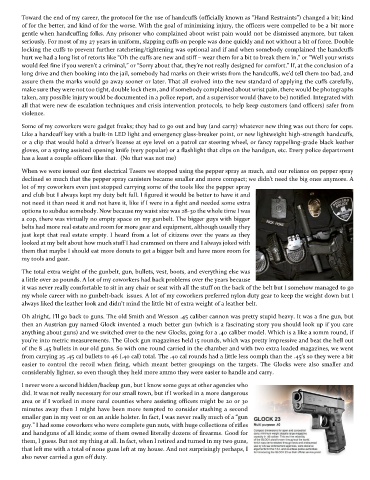
        Oh alright, I’ll go back to guns. The old Smith and Wesson .45 caliber cannon was pretty stupid heavy. It was a fine gun, but
        then an Austrian guy named Glock invented a much better gun (which is a fascinating story you should look up if you care
        anything about guns) and we switched over to the new Glocks, going for a .40 caliber model. Which is a like a 10mm round, if
        you’re into metric measurements. The Glock gun magazines held 15 rounds, which was pretty impressive and beat the hell out
        of the 8 .45 bullets in our old guns. So with one round carried in the chamber and with two extra loaded magazines, we went
        from carrying 25 .45 cal bullets to 46 (.40 cal) total. The .40 cal rounds had a little less oomph than the .45’s so they were a bit
        easier  to  control  the  recoil  when  firing,  which  meant  better  groupings  on  the  targets.  The  Glocks  were  also  smaller  and
        considerably lighter, so even though they held more ammo they were easier to handle and carry.

        I never wore a second hidden/backup gun, but I know some guys at other agencies who
        did. It was not really necessary for our small town, but if I worked in a more dangerous
        area or if I worked in more rural counties where assisting officers might be 20 or 30
        minutes away then I might have been more tempted to consider stashing a second
        smaller gun in my vest or on an ankle holster. In fact, I was never really much of a “gun
        guy.” I had some coworkers who were complete gun nuts, with huge collections of rifles
        and handguns of all kinds; some of them owned literally dozens of firearms. Good for
        them, I guess. But not my thing at all. In fact, when I retired and turned in my two guns,
        that left me with a total of none guns left at my house. And not surprisingly perhaps, I
        also never carried a gun off duty.

