


Page 355 - NIXBOOK
P. 355
POLICE CAMERAS & CELL PHONES

        I have to break this down into two completely separate sections when I write about cameras: This first section here covers still
        photography; the other part is about uniform body video cameras, which is much more interesting. And completely unforeseen
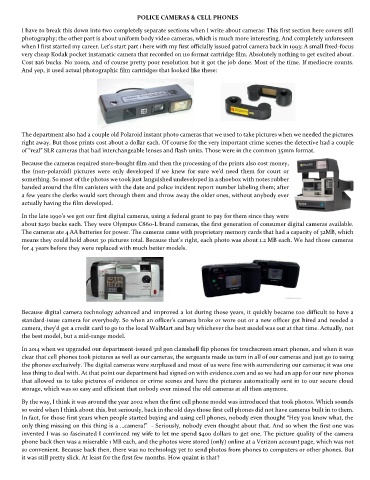
        when I first started my career. Let’s start part 1 here with my first officially issued patrol camera back in 1993: A small fixed-focus
        very cheap Kodak pocket instamatic camera that recorded on 110 format cartridge film. Absolutely nothing to get excited about.
        Cost $26 bucks. No zoom, and of course pretty poor resolution but it got the job done. Most of the time. If mediocre counts.
        And yep, it used actual photographic film cartridges that looked like these:


        The department also had a couple old Polaroid instant photo cameras that we used to take pictures when we needed the pictures
        right away. But those prints cost about a dollar each. Of course for the very important crime scenes the detective had a couple
        of “real” SLR cameras that had interchangeable lenses and flash units. Those were in the common 35mm format.

        Because the cameras required store-bought film and then the processing of the prints also cost money,
        the  (non-polaroid)  pictures  were  only  developed  if  we  knew  for  sure  we’d  need  them  for  court  or
        something. So most of the photos we took just languished undeveloped in a shoebox with notes rubber
        banded around the film canisters with the date and police incident report number labeling them; after
        a few years the clerks would sort through them and throw away the older ones, without anybody ever
        actually having the film developed.

        In the late 1990’s we got our first digital cameras, using a federal grant to pay for them since they were
        about $250 bucks each. They were Olympus C860-L brand cameras, the first generation of consumer digital cameras available.
        The cameras ate 4 AA batteries for power. The cameras came with proprietary memory cards that had a capacity of 32MB, which
        means they could hold about 30 pictures total. Because that’s right, each photo was about 1.2 MB each. We had those cameras
        for 4 years before they were replaced with much better models.


        Because digital camera technology advanced and improved a lot during those years, it quickly became too difficult to have a
        standard-issue camera for everybody. So when an officer’s camera broke or wore out or a new officer got hired and needed a
        camera, they’d get a credit card to go to the local WalMart and buy whichever the best model was out at that time. Actually, not
        the best model, but a mid-range model.

        In 2014 when we upgraded our department-issued 3rd gen clamshell flip phones for touchscreen smart phones, and when it was
        clear that cell phones took pictures as well as our cameras, the sergeants made us turn in all of our cameras and just go to using
        the phones exclusively. The digital cameras were surplused and most of us were fine with surrendering our cameras; it was one
        less thing to deal with. At that point our department had signed on with evidence.com and so we had an app for our new phones
        that allowed us to take pictures of evidence or crime scenes and have the pictures automatically sent in to our secure cloud
        storage, which was so easy and efficient that nobody ever missed the old cameras at all then anymore.
        By the way, I think it was around the year 2002 when the first cell phone model was introduced that took photos. Which sounds
        so weird when I think about this, but seriously, back in the old days those first cell phones did not have cameras built in to them.
        In fact, for those first years when people started buying and using cell phones, nobody even thought “Hey you know what, the
        only thing missing on this thing is a …camera!”  - Seriously, nobody even thought about that. And so when the first one was
        invented I was so fascinated I convinced my wife to let me spend $400 dollars to get one. The picture quality of the camera
        phone back then was a miserable 1 MB each, and the photos were stored (only) online at a Verizon account page, which was not
        so convenient. Because back then, there was no technology yet to send photos from phones to computers or other phones. But
        it was still pretty slick. At least for the first few months. How quaint is that?

