


Page 354 - NIXBOOK
P. 354
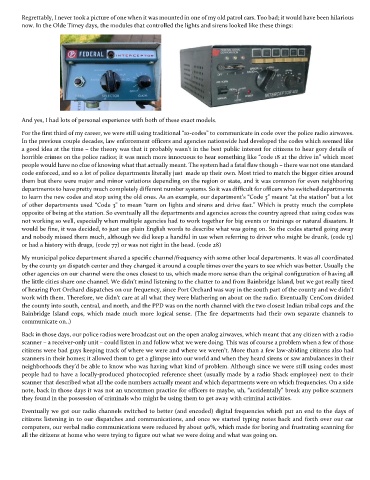
Regrettably, I never took a picture of one when it was mounted in one of my old patrol cars. Too bad; it would have been hilarious
        now. In the Olde Timey days, the modules that controlled the lights and sirens looked like these things:


        And yes, I had lots of personal experience with both of these exact models.

        For the first third of my career, we were still using traditional “10-codes” to communicate in code over the police radio airwaves.
        In the previous couple decades, law enforcement officers and agencies nationwide had developed the codes which seemed like
        a good idea at the time – the theory was that it probably wasn’t in the best public interest for citizens to hear gory details of
        horrible crimes on the police radios; it was much more innocuous to hear something like “code 18 at the drive in” which most
        people would have no clue of knowing what that actually meant. The system had a fatal flaw though – there was not one standard
        code enforced, and so a lot of police departments literally just  made up their own. Most tried to match the bigger cities around
        them but there were major and minor variations depending on the region or state, and it was common for even neighboring
        departments to have pretty much completely different number systems. So it was difficult for officers who switched departments
        to learn the new codes and stop using the old ones. As an example, our department’s “Code 3” meant “at the station” but a lot
        of other departments used “Code 3” to mean “turn on lights and sirens and drive fast.” Which is pretty much the complete
        opposite of being at the station. So eventually all the departments and agencies across the country agreed that using codes was
        not working so well, especially when multiple agencies had to work together for big events or trainings or natural disasters. It
        would be fine, it was decided, to just use plain English words to describe what was going on. So the codes started going away
        and nobody missed them much, although we did keep a handful in use when referring to driver who might be drunk, (code 13)
        or had a history with drugs, (code 77) or was not right in the head. (code 28)

        My municipal police department shared a specific channel/frequency with some other local departments. It was all coordinated
        by the county 911 dispatch center and they changed it around a couple times over the years to see which was better. Usually the
        other agencies on our channel were the ones closest to us, which made more sense than the original configuration of having all
        the little cities share one channel. We didn’t mind listening to the chatter to and from Bainbridge Island, but we got really tired
        of hearing Port Orchard dispatches on our frequency, since Port Orchard was way in the south part of the county and we didn’t
        work with them. Therefore, we didn’t care at all what they were blathering on about on the radio. Eventually CenCom divided
        the county into south, central, and north, and the PPD was on the north channel with the two closest Indian tribal cops and the
        Bainbridge  Island  cops,  which  made  much  more  logical  sense.  (The  fire  departments  had  their  own  separate  channels  to
        communicate on..)
        Back in those days, our police radios were broadcast out on the open analog airwaves, which meant that any citizen with a radio
        scanner – a receiver-only unit – could listen in and follow what we were doing. This was of course a problem when a few of those
        citizens were bad guys keeping track of where we were and where we weren’t. More than a few law-abiding citizens also had
        scanners in their homes; it allowed them to get a glimpse into our world and when they heard sirens or saw ambulances in their
        neighborhoods they’d be able to know who was having what kind of problem. Although since we were still using codes most
        people had to have a locally-produced photocopied reference sheet (usually made by a radio Shack employee) next to their
        scanner that described what all the code numbers actually meant and which departments were on which frequencies. On a side
        note, back in those days it was not an uncommon practice for officers to maybe, uh, “accidentally” break any police scanners
        they found in the possession of criminals who might be using them to get away with criminal activities.
        Eventually we got our radio channels switched to better (and encoded) digital frequencies which put an end to the days of
        citizens listening in to our dispatches and communications, and once we started typing notes back and forth over our car
        computers, our verbal radio communications were reduced by about 90%, which made for boring and frustrating scanning for
        all the citizens at home who were trying to figure out what we were doing and what was going on.

