


Page 348 - NIXBOOK
P. 348
But I did enjoy target practice, although my scores were just average, and I
        was okay with that. The way I saw it, if I could get all 50 bullets (in the
        quarterly testing) anywhere near the middle of the man-shaped target on
        the paper, then I was satisfied. Maybe they wouldn’t all be dead center in a
        tiny  little  grouping,  but  I  felt  reasonably  confident  that  if  it  were  a  real
        person I had to shoot at, I’d be able to drop him by the second or third shot
        at the most. I will say though that I was an excellent shot with my rifle  -
        either with the scope or with the built-in sights- and I could put bullets all
        day in a very small circle downrange at a hundred yards, easily.


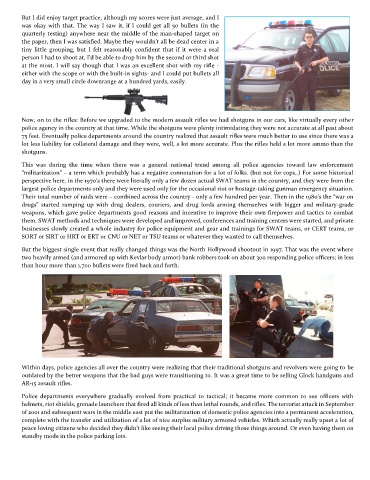
        Now, on to the rifles: Before we upgraded to the modern assault rifles we had shotguns in our cars, like virtually every other
        police agency in the country at that time. While the shotguns were plenty intimidating they were not accurate at all past about
        75 feet. Eventually police departments around the country realized that assault rifles were much better to use since there was a
        lot less liability for collateral damage and they were, well, a lot more accurate. Plus the rifles held a lot more ammo than the
        shotguns.
        This  was  during  the  time  when  there  was  a  general  national  trend  among  all  police  agencies  toward  law  enforcement
        “militarization” – a term which probably has a negative connotation for a lot of folks. (but not for cops..) For some historical
        perspective here, in the 1970’s there were literally only a few dozen actual SWAT teams in the country, and they were from the
        largest police departments only and they were used only for the occasional riot or hostage-taking gunman emergency situation.
        Their total number of raids were – combined across the country - only a few hundred per year. Then in the 1980’s the “war on
        drugs”  started  ramping  up  with  drug  dealers,  couriers,  and  drug  lords  arming  themselves  with  bigger  and  military-grade
        weapons, which gave police departments good reasons and incentive to improve their own firepower and tactics to combat
        them. SWAT methods and techniques were developed and improved, conferences and training centers were started, and private
        businesses slowly created a whole industry for police equipment and gear and trainings for SWAT teams, or CERT teams, or
        SORT or SIRT or HRT or ERT or CNU or NET or TSU teams or whatever they wanted to call themselves.

        But the biggest single event that really changed things was the North Hollywood shootout in 1997. That was the event where
        two heavily armed (and armored up with Kevlar body armor) bank robbers took on about 300 responding police officers; in less
        than hour more than 1,700 bullets were fired back and forth.


        Within days, police agencies all over the country were realizing that their traditional shotguns and revolvers were going to be
        outdated by the better weapons that the bad guys were transitioning to. It was a great time to be selling Glock handguns and
        AR-15 assault rifles.

        Police  departments  everywhere  gradually  evolved  from  practical  to  tactical;  it  became  more  common  to  see  officers  with
        helmets, riot shields, grenade launchers that fired all kinds of less than lethal rounds, and rifles. The terrorist attack in September
        of 2001 and subsequent wars in the middle east put the militarization of domestic police agencies into a permanent acceleration,
        complete with the transfer and utilization of a lot of nice surplus military armored vehicles. Which actually really upset a lot of
        peace loving citizens who decided they didn’t like seeing their local police driving those things around. Or even having them on
        standby mode in the police parking lots.

