


Page 357 - NIXBOOK
P. 357
BODY CAMS

        The good, the bad, and ugly…welcome to the wonderful world of uniform body cameras!
        Pros: Relatively inexpensive to buy. Easy to use. Can exonerate an officer’s actions.

        Cons: Requires a lot of expensive data storage. Can implicate an officer’s actions.

        Actually  the  official  list  of  pros  and  cons  is  much,  much
        longer. Cameras can record a lot of things that officers might
        (or might not) see and just as importantly to note, they don’t
        record a lot of things that the officers might (or might not)
        see. As you can imagine, this raises all sort of considerations
        and consequences when, say, a police shooting is recorded
        and  the  camera  recording  causes  more  questions  than
        answers.

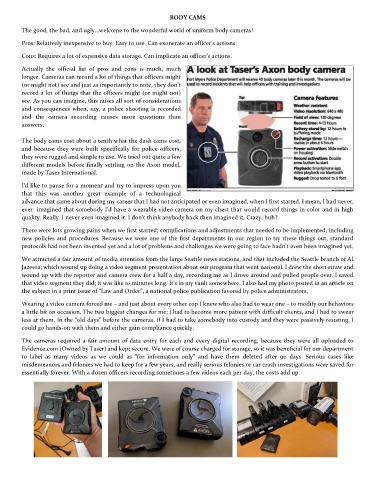
        The body cams cost about a tenth what the dash cams cost,
        and  because  they  were  built  specifically  for  police  officers,
        they were rugged and simple to use. We tried out quite a few
        different models before finally settling on the Axon model,
        made by Taser International.

        I’d like to pause for a moment and try to impress upon you
        that  this  was  another  great  example  of  a  technological
        advance that came about during my career that I had not anticipated or even imagined, when I first started. I mean, I had never,
        ever  imagined that somebody I’d have a wearable video camera on my chest that would record things in color and in high
        quality. Really. I never even imagined it. I don’t think anybody back then imagined it. Crazy, huh?

        There were lots growing pains when we first started; complications and adjustments that needed to be implemented, including
        new policies and procedures. Because we were one of the first departments in our region to try these things out, standard
        protocols had not been invented yet and a lot of problems and challenges we were going to face hadn’t even been imagined yet.

        We attracted a fair amount of media attention from the large Seattle news stations, and that included the Seattle branch of Al
        Jazeera; which wound up doing a video segment presentation about our program that went national. I drew the short straw and
        wound up with the reporter and camera crew for a half a day, recording me as I drove around and pulled people over. I saved
        that video segment they did; it was like 10 minutes long. It’s in my vault somewhere. I also had my photo posted in an article on
        the subject in a print issue of “Law and Order”, a national police publication favored by police administrators.
        Wearing a video camera forced me – and just about every other cop I knew who also had to wear one – to modify our behaviors
        a little bit on occasion. The two biggest changes for me; I had to become more patient with difficult clients, and I had to swear
        less at them. In the “old days” before the cameras, if I had to take somebody into custody and they were passively resisting, I
        could go hands-on with them and either gain compliance quickly.

        The cameras required a fair amount of data entry for each and every  digital recording, because they were all uploaded to
        Evidence.com (Owned by Taser) and kept secure. We were of course charged for storage, so it was beneficial for our department
        to  label  as  many  videos  as  we  could  as  “for  information  only”  and  have  them  deleted  after  90  days.  Serious  cases  like
        misdemeanors and felonies we had to keep for a few years, and really serious felonies or car crash investigations were saved for
        essentially forever. With a dozen officers recording sometimes a few videos each per day, the costs add up.

