


Page 265 - NIXBOOK
P. 265
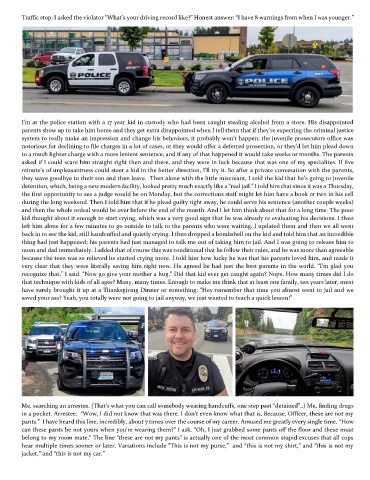
Traffic stop: I asked the violator “What’s your driving record like?” Honest answer: “I have 8 warnings from when I was younger.”


        I’m at the police station with a 17 year kid in custody who had been caught stealing alcohol from a store. His disappointed
        parents show up to take him home and they get extra disappointed when I tell them that if they’re expecting the criminal justice
        system to really make an impression and change his behaviors, it probably won’t happen; the juvenile prosecutors office was
        notorious for declining to file charges in a lot of cases, or they would offer a deferred prosection, or they’d let him plead down
        to a much lighter charge with a more lenient sentence, and if any of that happened it would take weeks or months. The parents
        asked if I could scare him straight right then and there, and they were in luck because that was one of my specialites. If five
        minute’s of unpleasantness could steer a kid in the better direction, I’ll try it. So after a private convesation with the parents,
        they wave goodbye to their son and then leave.  Then alone with the little miscreant, I told the kid that he’s going to juvenile
        detention, which, being a new modern facility, looked pretty much exactly like a “real jail.” I told him that since it was a Thursday,
        the first opportunity to see a judge would be on Monday, but the corrections staff might let him have a book or two in his cell
        during the long weekend. Then I told him that if he plead guilty right away, he could serve his sentence (another couple weeks)
        and then the whole ordeal would be over before the end of the month. And I let him think about that for a long time. The poor
        kid thought about it enough to start crying, which was a very good sign that he was already re evaluating his decisions. I then
        left him alone for a few minutes to go outside to talk to the parents who were waiting. I updated them and then we all went
        back in to see the kid, still handcuffed and quietly crying. I then dropped a bombshell on the kid and told him that an incredible
        thing had just happened; his parents had just managed to talk me out of taking him to jail. And I was going to release him to
        mom and dad immediately. I added that of course this was conditional that he follow their rules, and he was more than agreeable
        because the teen was so relieved he started crying more. I told him how lucky he was that his parents loved him, and made it
        very clear that they were literally saving him right now. He agreed he had just the best parents in the world. “I’m glad you
        recognize that,” I said. “Now go give your mother a hug.” Did that kid ever get caught again? Nope. How many times did I do
        that technique with kids of all ages? Many, many times. Enough to make me think that at least one family, ten years later, must
        have surely brought it up at a Thanksgiving Dinner or something: “Hey remember that time you almost went to jail and we
        saved your ass? Yeah, you totally were not going to jail anyway, we just wanted to teach a quick lesson!”


        Me, searching an arrestee. (That’s what you can call somebody wearing handcuffs, one step past “detained”..) Me, finding drugs
        in a pocket. Arrestee:  “Wow, I did not know that was there. I don’t even know what that is. Because, Officer, these are not my
        pants.”  I have heard this line, incredibly, about 7 times over the course of my career. Amused me greatly every single time. “How
        can these pants be not yours when you’re wearing them?” I ask. “Oh, I just grabbed some pants off the floor and these must
        belong to my room mate.” The line “these are not my pants” is actually one of the most common stupid excuses that all cops
        hear multiple times sooner or later. Variations include “This is not my purse,”  and “this is not my shirt,” and “this is not my
        jacket,” and “this is not my car.”

