


Page 16 - Integrity Seminars - Special Report
P. 16
Douglass’s   newspaper   debates   were   not         holding  ourselves  perfectly  free  to  change  our
            rhetorical  exercises.  He  grappled  with  difficult   opinion in any direction, and at any time which
            issues  and  sometimes  changed  his  mind.           may   be   indicated   by   our   immediate
            Perhaps  the  best  example  was  his  protracted     apprehension of truth, unbiased by the smiles or
            dialogue  with  fellow  abolitionist  Gerrit  Smith   frowns of any class or party of abolitionists. The
            about    whether    the   Constitution   was
                                                                  only truly consistent man is he who will, for the
            "pro-slavery." Douglass initially contended it was,
                                                                  sake  of  being  right  today,  contradict  what  he
            but  eventually  argued  a  contrary  position  in
                                                                  said wrong yesterday. “Sufficient unto the day is
            1860  --after  telling  Smith  in  1851  he  was  "so
                                                                  the  evil  thereof.”  True  stability  consists  not  in
            much impressed" by his reasoning and was "sick
                                                                  being of the same opinion now as formerly, but in
            and tired of arguing on the slaveholders’ side of
                                                                  a fixed principle of honesty, even urging us to the
            this question."
                                                                  adoption or rejection of  that which may seem to
                                                                  us true or false at the ever-present now.


                                                                How can educators convey both the theory and
                                                                practice of Douglass’s foundational commitment
                                                                to  truth-seeking,  truth-telling,  and  freedom  of
                                                                expression? One starting point is to engage with
                                                                students  on    Douglass’s  legacy  in  this  regard
                                                                and highlight a powerful contemporary variation
                                                                argued  by  President  Obama  in  his  2016
                                                                commencement address at Rutgers University:


                                                                  If  you  disagree  with  somebody,  bring  them  in
                                                                  and ask them tough questions. Hold their feet to
                                                                  the  fire.  Make  them  defend  their  positions.    If
                                                                  somebody has got a bad or offensive idea, prove
                                                                  it wrong. Engage it. Debate it. Stand up for what
                                                                  you believe in.  Don't be scared to take somebody
                                                                  on.  Don't  feel  like  you  got  to  shut  your  ears  off
                                                                  because you're too fragile and somebody might

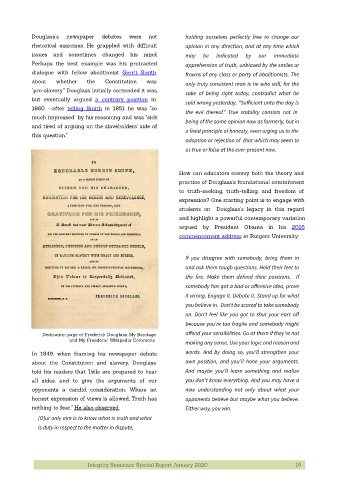
                Dedication page of Frederick Douglass, My Bondage   offend your sensibilities. Go at them if they’re not
                         and My Freedom/ Wikipedia Commons
                                                                  making any sense. Use your logic and reason and
            In  1849,  when  framing  his  newspaper  debate      words.  And  by  doing  so,  you’ll  strengthen  your
            about  the  Constitution  and  slavery,  Douglass     own  position,  and  you’ll  hone  your  arguments.
            told his readers that "[w]e are prepared to hear      And  maybe  you’ll  learn  something  and  realize
            all  sides,  and  to  give  the  arguments  of  our   you don't know everything. And you may have a
            opponents  a  candid  consideration.  Where  an       new  understanding  not  only  about  what  your
            honest expression of views is allowed, Truth has      opponents believe but maybe what you believe.
            nothing to fear." He also observed:                   Either way, you win.
              [O]ur only aim is to know what is truth and what
              is duty in respect to the matter in dispute,


                                Integrity Seminars: Special Report January 2020                          16

