


Page 397 - NIXBOOK
P. 397
technology was pretty crude; the police cars had 4 extra antennas on the roof and a small dash mount display that pretty much
        showed just an arrow that gave the rough direction of where the car was; it was up to the officer to visually narrow down where
        exactly the car was. When we had that technology we got only a few hits but nothing close enough to actually catch stolen car
        passing through.

        We had had the mobile computers for several years before all of the GPS
        capabilities came on line. At first we were quite resistant to the idea of having
        our police car locations be tracked live by the dispatches and supervisors but
        we got over it. The MCT’s continued to get upgrades over the years with more
        software programs, including a very nifty hand-held bar code scanner device
        that  could  optically  laser  scan  drivers  licenses  and  vehicle  registration
        certificates. When that happened we transitioned from hand-writing traffic
        tickets to scanning and typing in the data. A small thermal printer mounted
        between the front seats would print out one copy to issue to our customer
        and  the  court  copy  would  be  electronically  sent  to  the  court.  That  was  a
        terrific improvement over the old hand writing method.

        The Washington State Patrol then digitized their collision report forms, which previously required about an hour to fill out in
        triplicate by hand and included a couple dozen extra code boxes for weather conditions, road conditions, vehicle defects, driver
        actions,  etc.  It  became  way  easier  on  the  MCT,  especially  being  able  to  scan  people’s  licenses  and  all  their  data  would
        automatically be filled in.  And the collision diagrams were then computer created instead of hand drawn with little rulers and
        templates.

        With the computers up and running, the officers on patrol were able leave the dispatchers alone and check names and license
        plates themselves, by accessing state and national databases. Like most of my coworkers I became quite adept at quickly typing
        on the keyboard with my right hand while using my left hand for driving.

        Eventually most of our police cars had to have emergency battery shut-off systems added to solve the problem of our batteries
        dying while on duty; if a police car was parked too long with the engine off and all the electronics were draining the battery,
        we’d have to jump-start them with another car and jumper cables to revive it. The battery shut off systems were great; when the
        battery got close to dying, it would get simply trigger the system to shut everything down to save enough reserve energy to
        restart the car. Before we had those, I had to manually jump start my one of my patrol cars literally dozens of times over the
        years.

        Needless to say, I spent a lot of time in my police cars, driving around on patrol and idling by the roadside or in parking lots
        looking around, waiting, watching, and keeping an eye out for bad guys, bad cars, suspicious things, etc. Conservatively speaking,
        I can saw I put well over a quarter million miles on the odometers during my police career. I liked to drive with my driver’s
        window down so I could hear things better, and usually had the FM radio on to listen to the Seattle news talk shows.
        We used to refuel at the city’s public works shop where an old gas tank was underground but that got taken out to make way
        for a new road so we got our gas from then on at the Cenex feed store. I got into the habit of checking my back seat whenever I
        refueled, since I had clients back there who would occasionally feel a need to empty their pockets of whatever contraband they
        had hidden. More than once I found little baggies or bindles of drugs jammed into the seat cushions or tossed onto the floor.
        Sometimes I knew who had put them there, sometimes I had no clue. Even when I did know though, there would never be any
        way to prove it conclusively enough in a court of law to support a criminal charge, so I never bothered, I just threw it away when
        it happened.

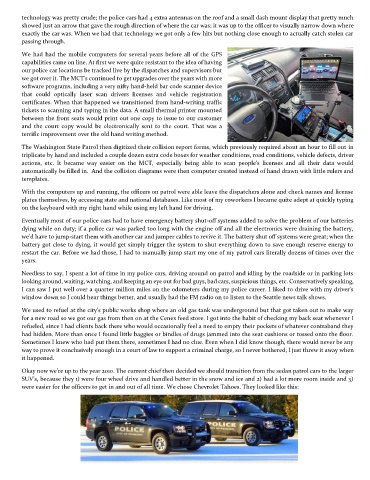
        Okay now we’re up to the year 2010. The current chief then decided we should transition from the sedan patrol cars to the larger
        SUV’s, because they 1) were four wheel drive and handled better in the snow and ice and 2) had a lot more room inside and 3)
        were easier for the officers to get in and out of all time. We chose Chevrolet Tahoes. They looked like this:

