


Page 396 - NIXBOOK
P. 396
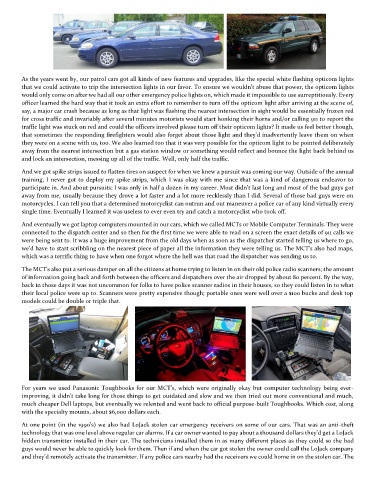
As the years went by, our patrol cars got all kinds of new features and upgrades, like the special white flashing opticom lights
        that we could activate to trip the intersection lights in our favor. To ensure we wouldn’t abuse that power, the opticom lights
        would only come on after we had all our other emergency police lights on, which made it impossible to use surreptitiously. Every
        officer learned the hard way that it took an extra effort to remember to turn off the opticom light after arriving at the scene of,
        say, a major car crash because as long as that light was flashing the nearest intersection in sight would be essentially frozen red
        for cross traffic and invariably after several minutes motorists would start honking their horns and/or calling 911 to report the
        traffic light was stuck on red and could the officers involved please turn off their opticom lights? It made us feel better though,
        that sometimes the responding firefighters would also forget about those light and they’d inadvertently leave them on when
        they were on a scene with us, too. We also learned too that it was very possible for the opticom light to be pointed deliberately
        away from the nearest intersection but a gas station window or something would reflect and bounce the light back behind us
        and lock an intersection, messing up all of the traffic. Well, only half the traffic.

        And we got spike strips issued to flatten tires on suspect for when we knew a pursuit was coming our way. Outside of the annual
        training, I never got to deploy my spike strips, which I was okay with me since that was a kind of dangerous endeavor to
        participate in. And about pursuits: I was only in half a dozen in my career. Most didn’t last long and most of the bad guys got
        away from me, usually because they drove a lot faster and a lot more recklessly than I did. Several of those bad guys were on
        motorcycles. I can tell you that a determined motorcyclist can outrun and out maneuver a police car of any kind virtually every
        single time. Eventually I learned it was useless to ever even try and catch a motorcyclist who took off.

        And eventually we got laptop computers mounted in our cars, which we called MCTs or Mobile Computer Terminals. They were
        connected to the dispatch center and so then for the first time we were able to read on a screen the exact details of 911 calls we
        were being sent to. It was a huge improvement from the old days when as soon as the dispatcher started telling us where to go,
        we’d have to start scribbling on the nearest piece of paper all the information they were telling us. The MCT’s also had maps,
        which was a terrific thing to have when one forgot where the hell was that road the dispatcher was sending us to.

        The MCT’s also put a serious damper on all the citizens at home trying to listen in on their old police radio scanners; the amount
        of information going back and forth between the officers and dispatchers over the air dropped by about 80 percent. By the way,
        back in those days it was not uncommon for folks to have police scanner radios in their houses, so they could listen in to what
        their local police were up to. Scanners were pretty expensive though; portable ones were well over a $100 bucks and desk top
        models could be double or triple that.


        For years we used Panasonic Toughbooks for our MCT’s, which were originally okay but computer technology being ever-
        improving, it didn’t take long for those things to get outdated and slow and we then tried out more conventional and much,
        much cheaper Dell laptops, but eventually we relented and went back to official purpose-built Toughbooks. Which cost, along
        with the specialty mounts, about $6,000 dollars each.

        At one point (in the 1990’s) we also had LoJack stolen car emergency receivers on some of our cars. That was an anti-theft
        technology that was one level above regular car alarms. If a car owner wanted to pay about a thousand dollars they’d get a LoJack
        hidden transmitter installed in their car. The technicians installed them in as many different places as they could so the bad
        guys would never be able to quickly look for them. Then if and when the car got stolen the owner could call the LoJack company
        and they’d remotely activate the transmitter. If any police cars nearby had the receivers we could home in on the stolen car. The

