


Page 393 - NIXBOOK
P. 393
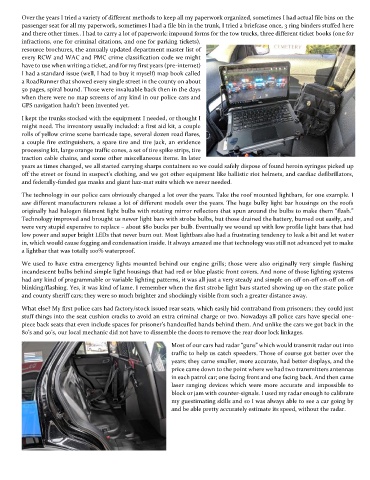
Over the years I tried a variety of different methods to keep all my paperwork organized, sometimes I had actual file bins on the
        passenger seat for all my paperwork, sometimes I had a file bin in the trunk, I tried a briefcase once, 3 ring binders stuffed here
        and there other times.. I had to carry a lot of paperwork: impound forms for the tow trucks, three different ticket books (one for
        infractions, one for criminal citations, and one for parking tickets),
        resource brochures, the annually updated department master list of
        every RCW and WAC and PMC crime classification code we might
        have to use when writing a ticket, and for my first years (pre-internet)
        I had a standard issue (well, I had to buy it myself) map book called
        a RoadRunner that showed every single street in the county on about
        50 pages, spiral bound. Those were invaluable back then in the days
        when there were no map screens of any kind in our police cars and
        GPS navigation hadn’t been invented yet.

        I kept the trunks stocked with the equipment I needed, or thought I
        might need. The inventory usually included: a first aid kit, a couple
        rolls of yellow crime scene barricade tape, several dozen road flares,
        a  couple  fire  extinguishers,  a  spare  tire  and  tire  jack,  an  evidence
        processing kit, large orange traffic cones, a set of tire spike strips, tire
        traction cable chains, and some other miscellaneous items. In later
        years as times changed, we all started carrying sharps containers so we could safely dispose of found heroin syringes picked up
        off the street or found in suspect’s clothing, and we got other equipment like ballistic riot helmets, and cardiac defibrillators,
        and federally-funded gas masks and giant haz-mat suits which we never needed.

        The technology in our police cars obviously changed a lot over the years. Take the roof mounted lightbars, for one example. I
        saw different manufacturers release a lot of different models over the years. The huge bulky light bar housings on the roofs
        originally had halogen filament light bulbs with rotating mirror reflectors that spun around the bulbs to make them “flash.”
        Technology improved and brought us newer light bars with strobe bulbs, but those drained the battery, burned out easily, and
        were very stupid expensive to replace – about $80 bucks per bulb. Eventually we wound up with low profile light bars that had
        low power and super bright LEDs that never burn out. Most lightbars also had a frustrating tendency to leak a bit and let water
        in, which would cause fogging and condensation inside. It always amazed me that technology was still not advanced yet to make
        a lightbar that was totally 100% waterproof.

        We used to have extra emergency lights mounted behind our engine grills; those were also originally very simple flashing
        incandescent bulbs behind simple light housings that had red or blue plastic front covers. And none of those lighting systems
        had any kind of programmable or variable lighting patterns, it was all just a very steady and simple on-off on-off on-off on-off
        blinking/flashing. Yes, it was kind of lame. I remember when the first strobe light bars started showing up on the state police
        and county sheriff cars; they were so much brighter and shockingly visible from such a greater distance away.

        What else? My first police cars had factory/stock issued rear seats, which easily hid contraband from prisoners; they could just
        stuff things into the seat cushion cracks to avoid an extra criminal charge or two. Nowadays all police cars have special one-
        piece back seats that even include spaces for prisoner’s handcuffed hands behind them. And unlike the cars we got back in the
        80’s and 90’s, our local mechanic did not have to dissemble the doors to remove the rear door lock linkages.

                                                          Most of our cars had radar “guns” which would transmit radar out into
                                                          traffic to help us catch speeders. Those of course got better over the
                                                          years; they came smaller, more accurate, had better displays, and the
                                                          price came down to the point where we had two transmitters antennas
                                                          in each patrol car; one facing front and one facing back. And then came
                                                          laser  ranging  devices  which  were  more  accurate  and  impossible  to
                                                          block or jam with counter-signals. I used my radar enough to calibrate
                                                          my guestimating skills and so I was always able to see a car going by
                                                          and be able pretty accurately estimate its speed, without the radar.

