


Page 2 - Integrity Seminars - Special Report
P. 2
In a remarkable development in human history,      a  form  of  "property  in  man"  that  may  have
             the  same  Western  societies  that  produced      "exceeded  the  invested  value  of  all  of  the
             perhaps  the  most  deeply  entrenched  and        nation's   railroads,   factories,   and   Banks
             exploitative  form  of  slavery  also  generated   combined."  The  mystery,  in  short,  is  not  the
             antislavery movements leading to its abolition.    existence  or  expansion  of  slavery  worldwide.
             Concurrent  with  the  founding  of  the  United   The  mystery  is  how  slavery  ever  came  to  be
             States, for example, came the founding in 1775     abolished.
             of the Pennsylvania Society for Promoting the
             Abolition   of   Slavery   ("the   world’s   first   If we are to better understand our history and
             antislavery society").                             aspirational future, any study of slavery should
                                                                also include study of antislavery. Learning more
                                                                about Frederick Douglass-- and what Douglass
             Professor   Drescher   expanded   upon   this      can      teach     contemporary       college
             perspective  in  his  2009  book  Abolition:  A    students--provides an opening to this important
             History of Slavery and Antislavery (p.461):        topic.


               [T]he  global  achievements  of  antislavery  a
               century  ago  left  two  indelible  legacies.  In  the
               course of a century and a half (1770s–1920s), it

               destroyed  or  sharply  restricted  an  institution,
               which had devastated and abbreviated the lives
               of  tens  of  millions  of  human  beings  in  two
               hemispheres.  By  the  mid-twentieth  century,  it
               succeeded in reasserting slavery's position at the
               top  of  the  list  of  practices  condemned  in  the
               Universal Declaration of Human Rights. For more
               than  sixty  years,  reviving  slavery  has  remained
               beyond  the  bounds  of  any  contemporary
               movement's  dreams  or  any  state's  ambition.
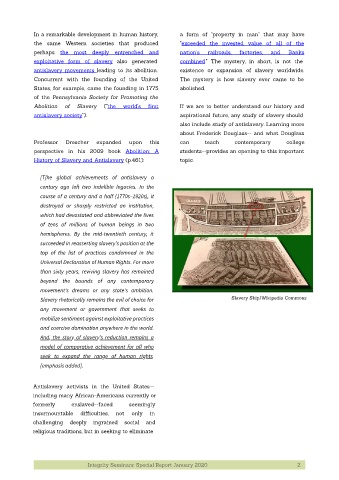
                                                                                  Slavery Ship/Wikipedia Commons
               Slavery rhetorically remains the evil of choice for
               any  movement  or  government  that  seeks  to
               mobilize sentiment against exploitative practices
               and coercive domination anywhere in the world.

               And,  the  story  of  slavery’s  reduction  remains  a
               model  of  comparative  achievement  for  all  who
               seek  to  expand  the  range  of  human  rights
               [emphasis added].


             Antislavery  activists  in  the  United  States--
             including many African-Americans currently or
             formerly     enslaved--faced     seemingly
             insurmountable   difficulties,   not   only   in
             challenging  deeply  ingrained  social  and
             religious traditions, but in seeking to eliminate


                                Integrity Seminars: Special Report January 2020                          2

