


Page 374 - NIXBOOK
P. 374
RESERVE OFFICER COORDINATOR & FIELD TRAINING OFFICER

        Because  I  guess  I  was  a  motivated  go-getter,  I  also  took  on  the  duty  of  being  the  department’s  Reserve  Officer  Program
        Coordinator for a few years, which is what you call the guy who manages and oversees the volunteer (unpaid) officers. During
        that time I recruited and hired a dozen new volunteer police officers and I helped them through our multi-jurisdictional county
        reserve schooling course. Later I also fired about half of them for various offenses, because, well..reasons. I liked being their
        supervisor but I was always a little nervous one of them would do something bad and cause a huge lawsuit against the city and
        drag me into it for failing to train them on some particular aspect of something. So I kept them all well trained about everything
        and I enjoyed being their leader and teaching them things. I wrote a new training manual and qualifications guide for them all,
        and they rode with me and the other officers a lot. Some eventually qualified and progressed to solo patrol, meaning they could
        go out and inflict law and order on the general public all by themselves.

        I remember one night we had a training on how to do building searches, specifically how to methodically and safely clear rooms
        at gunpoint while looking for bad guys hiding. I had managed to talk a local interior design store business owner into letting me
        use his new place, which had a lot of interesting display rooms connected by strange passageways. I sent the new reserve officers
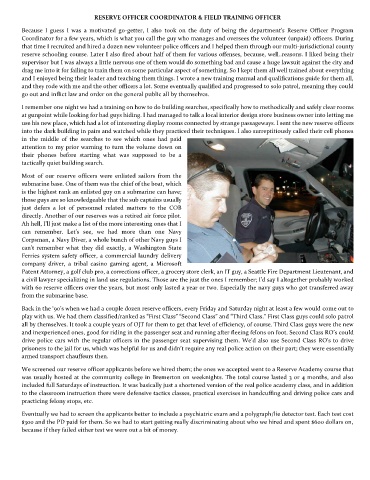
        into the dark building in pairs and watched while they practiced their techniques. I also surreptitiously called their cell phones
        in  the  middle  of  the  searches  to  see  which  ones  had  paid
        attention to my prior warning to turn the volume down on
        their  phones  before  starting  what  was  supposed  to  be  a
        tactically quiet building search.

        Most  of  our  reserve  officers  were  enlisted  sailors  from  the
        submarine base. One of them was the chief of the boat, which
        is the highest rank an enlisted guy on a submarine can have;
        those guys are so knowledgeable that the sub captains usually
        just  defers  a  lot  of  personnel  related  matters  to  the  COB
        directly. Another of our reserves was a retired air force pilot.
        Ah hell, I’ll just make a list of the more interesting ones that I
        can  remember.  Let’s  see,  we  had  more  than  one  Navy
        Corpsman, a Navy Diver, a whole bunch of other Navy guys I
        can’t remember what they  did exactly, a Washington  State
        Ferries system safety officer, a commercial laundry delivery
        company  driver,  a  tribal  casino  gaming  agent,  a  Microsoft
        Patent Attorney, a golf club pro, a corrections officer, a grocery store clerk, an IT guy, a Seattle Fire Department Lieutenant, and
        a civil lawyer specializing in land use regulations. Those are the just the ones I remember; I’d say I altogether probably worked
        with 60 reserve officers over the years, but most only lasted a year or two. Especially the navy guys who got transferred away
        from the submarine base.

        Back in the ‘90’s when we had a couple dozen reserve officers, every Friday and Saturday night at least a few would come out to
        play with us. We had them classified/ranked as “First Class” “Second Class” and “Third Class.” First Class guys could solo patrol
        all by themselves. It took a couple years of OJT for them to get that level of efficiency, of course. Third Class guys were the new
        and inexperienced ones, good for riding in the passenger seat and running after fleeing felons on foot. Second Class RO’s could
        drive police cars with the regular officers in the passenger seat supervising them. We’d also use Second Class RO’s to drive
        prisoners to the jail for us, which was helpful for us and didn’t require any real police action on their part; they were essentially
        armed transport chauffeurs then.

        We screened our reserve officer applicants before we hired them; the ones we accepted went to a Reserve Academy course that
        was usually hosted at the community college in Bremerton on weeknights. The total course lasted 3 or 4 months, and also
        included full Saturdays of instruction. It was basically just a shortened version of the real police academy class, and in addition
        to the classroom instruction there were defensive tactics classes, practical exercises in handcuffing and driving police cars and
        practicing felony stops, etc.

        Eventually we had to screen the applicants better to include a psychiatric exam and a polygraph/lie detector test. Each test cost
        $300 and the PD paid for them. So we had to start getting really discriminating about who we hired and spent $600 dollars on,
        because if they failed either test we were out a bit of money.

