


Page 373 - NIXBOOK
P. 373
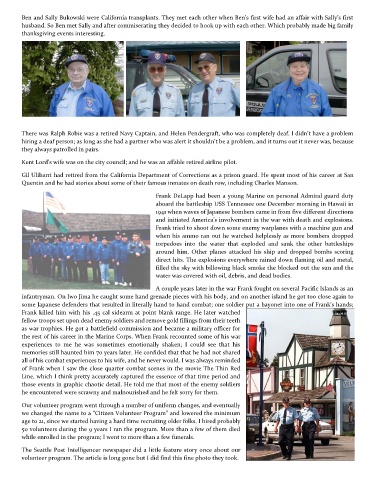
Ben and Sally Bukowski were California transplants. They met each other when Ben’s first wife had an affair with Sally’s first
        husband. So Ben met Sally and after commiserating they decided to hook up with each other. Which probably made big family
        thanksgiving events interesting.


        There was Ralph Robie was a retired Navy Captain, and Helen Pendergraft, who was completely deaf. I didn’t have a problem
        hiring a deaf person; as long as she had a partner who was alert it shouldn’t be a problem, and it turns out it never was, because
        they always patrolled in pairs.

        Kent Lord’s wife was on the city council; and he was an affable retired airline pilot.

        Gil Ulibarri had retired from the California Department of Corrections as a prison guard. He spent most of his career at San
        Quentin and he had stories about some of their famous inmates on death row, including Charles Manson.

                                                     Frank DeLapp had been a young Marine on personal Admiral guard duty
                                                     aboard the battleship USS Tennessee one December morning in Hawaii in
                                                     1941 when waves of Japanese bombers came in from five different directions
                                                     and initiated America’s involvement in the war with death and explosions.
                                                     Frank tried to shoot down some enemy warplanes with a machine gun and
                                                     when his ammo ran out he watched helplessly as more bombers dropped
                                                     torpedoes  into  the  water  that  exploded  and  sank  the  other  battleships
                                                     around  him.  Other  planes  attacked  his  ship  and  dropped  bombs  scoring
                                                     direct hits. The explosions everywhere rained down flaming oil and metal,
                                                     filled the sky with billowing black smoke the blocked out the sun and the
                                                     water was covered with oil, debris, and dead bodies.

                                                     A couple years later in the war Frank fought on several Pacific Islands as an
        infantryman. On Iwo Jima he caught some hand grenade pieces with his body, and on another island he got too close again to
        some Japanese defenders that resulted in literally hand to hand combat; one soldier put a bayonet into one of Frank’s hands;
        Frank killed him with his .45 cal sidearm at point blank range. He later watched
        fellow troops set upon dead enemy soldiers and remove gold fillings from their teeth
        as war trophies. He got a battlefield commission and became a military officer for
        the rest of his career in the Marine Corps. When Frank recounted some of his war
        experiences  to  me  he  was  sometimes  emotionally  shaken;  I  could  see  that  his
        memories still haunted him 70 years later. He confided that that he had not shared
        all of his combat experiences to his wife, and he never would. I was always reminded
        of Frank when I saw the close quarter combat scenes in the movie The Thin Red
        Line, which I think pretty accurately captured the essence of that time period and
        those events in graphic chaotic detail. He told me that most of the enemy soldiers
        he encountered were scrawny and malnourished and he felt sorry for them.

        Our volunteer program went through a number of uniform changes, and eventually
        we changed the name to a “Citizen Volunteer Program” and lowered the minimum
        age to 21, since we started having a hard time recruiting older folks. I hired probably
        50 volunteers during the 9 years I ran the program. More than a few of them died
        while enrolled in the program; I went to more than a few funerals.
        The Seattle Post Intelligencer newspaper did a little feature story once about our
        volunteer program. The article is long gone but I did find this fine photo they took.

