


Page 412 - NIXBOOK
P. 412
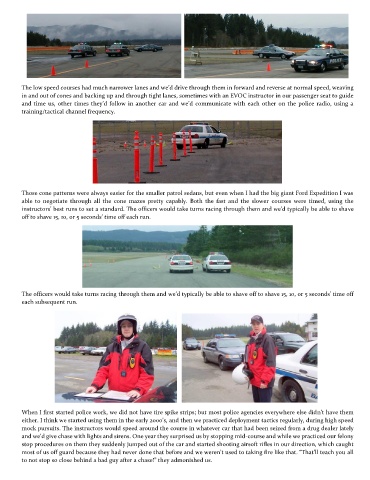
The low speed courses had much narrower lanes and we’d drive through them in forward and reverse at normal speed, weaving
        in and out of cones and backing up and through tight lanes, sometimes with an EVOC instructor in our passenger seat to guide
        and time us, other times they’d follow in another car and we’d communicate with each other on the police radio, using a
        training/tactical channel frequency.


        Those cone patterns were always easier for the smaller patrol sedans, but even when I had the big giant Ford Expedition I was
        able  to  negotiate  through  all  the  cone  mazes  pretty  capably.  Both  the  fast  and  the  slower  courses  were  timed,  using  the
        instructors’ best runs to set a standard. The officers would take turns racing through them and we’d typically be able to shave
        off to shave 15, 10, or 5 seconds’ time off each run.


        The officers would take turns racing through them and we’d typically be able to shave off to shave 15, 10, or 5 seconds’ time off
        each subsequent run.


        When I first started police work, we did not have tire spike strips; but most police agencies everywhere else didn’t have them
        either. I think we started using them in the early 2000’s, and then we practiced deployment tactics regularly, during high speed
        mock pursuits. The instructors would speed around the course in whatever car that had been seized from a drug dealer lately
        and we’d give chase with lights and sirens. One year they surprised us by stopping mid-course and while we practiced our felony
        stop procedures on them they suddenly jumped out of the car and started shooting airsoft rifles in our direction, which caught
        most of us off guard because they had never done that before and we weren’t used to taking fire like that. “That’ll teach you all
        to not stop so close behind a bad guy after a chase!” they admonished us.

