


Page 386 - NIXBOOK
P. 386
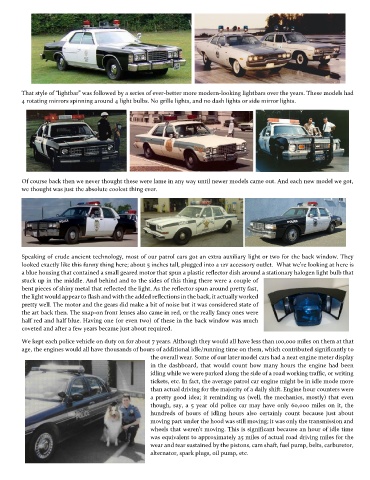
That style of “lightbar” was followed by a series of ever-better more modern-looking lightbars over the years. These models had
        4 rotating mirrors spinning around 4 light bulbs. No grille lights, and no dash lights or side mirror lights.


        Of course back then we never thought these were lame in any way until newer models came out. And each new model we got,
        we thought was just the absolute coolest thing ever.


        Speaking of crude ancient technology, most of our patrol cars got an extra auxiliary light or two for the back window. They
        looked exactly like this funny thing here; about 5 inches tall, plugged into a 12v accessory outlet.  What we’re looking at here is
        a blue housing that contained a small geared motor that spun a plastic reflector dish around a stationary halogen light bulb that
        stuck up in the middle. And behind and to the sides of this thing there were a couple of
        bent pieces of shiny metal that reflected the light. As the reflector spun around pretty fast,
        the light would appear to flash and with the added reflections in the back, it actually worked
        pretty well. The motor and the gears did make a bit of noise but it was considered state of
        the art back then. The snap-on front lenses also came in red, or the really fancy ones were
        half red and half blue. Having one (or even two) of these in the back window was much
        coveted and after a few years became just about required.

        We kept each police vehicle on duty on for about 7 years. Although they would all have less than 100,000 miles on them at that
        age, the engines would all have thousands of hours of additional idle/running time on them, which contributed significantly to
                                                   the overall wear. Some of our later model cars had a neat engine meter display
                                                   in the dashboard, that would  count  how many hours the engine had been
                                                   idling while we were parked along the side of a road working traffic, or writing
                                                   tickets, etc. In fact, the average patrol car engine might be in idle mode more
                                                   than actual driving for the majority of a daily shift. Engine hour counters were
                                                   a pretty good idea; it reminding us (well, the mechanics, mostly) that even
                                                   though,  say,  a  5  year  old  police  car  may  have  only  60,000  miles  on  it,  the
                                                   hundreds  of  hours  of  idling  hours  also  certainly  count  because  just  about
                                                   moving part under the hood was still moving; it was only the transmission and
                                                   wheels that weren’t moving. This is significant because an hour of idle time
                                                   was equivalent to approximately 25 miles of actual road driving miles for the
                                                   wear and tear sustained by the pistons, cam shaft, fuel pump, belts, carburetor,
                                                   alternator, spark plugs, oil pump, etc.

