


Page 365 - NIXBOOK
P. 365
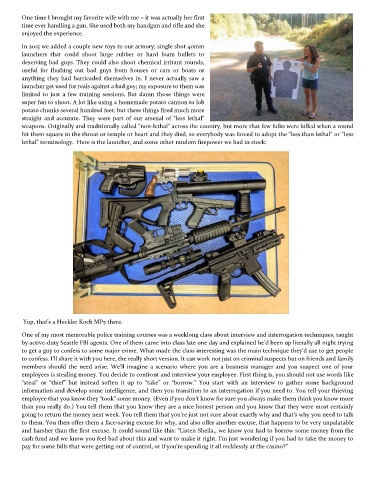
One time I brought my favorite wife with me – it was actually her first
        time ever handling a gun. She used both my handgun and rifle and she
        enjoyed the experience.

        In 2015 we added a couple new toys to our armory; single shot 40mm
        launchers  that  could  shoot  large  rubber  or  hard  foam  bullets  to
        deserving bad guys. They could also shoot chemical irritant rounds,
        useful  for  flushing  out  bad  guys  from  houses  or  cars  or  boats  or
        anything  they  had  barricaded  themselves  in.  I  never  actually  saw  a
        launcher get used for reals against a bad guy; my exposure to them was
        limited to just a few training sessions. But damn those things were
        super fun to shoot. A lot like using a homemade potato cannon to lob
        potato chunks several hundred feet; but these things fired much more
        straight and accurate. They were part of our arsenal of “less lethal”
        weapons. Originally and traditionally called “non-lethal” across the country, but more that few folks were killed when a round
        hit them square in the throat or temple or heart and they died, so everybody was forced to adopt the “less than lethal” or “less
        lethal” terminology.  Here is the launcher, and some other random firepower we had in stock:


         Yup, that’s a Heckler Koch MP5 there.
        One of my most memorable police training courses was a weeklong class about interview and interrogation techniques, taught
        by active-duty Seattle FBI agents. One of them came into class late one day and explained he’d been up literally all night trying
        to get a guy to confess to some major crime. What made the class interesting was the main technique they’d use to get people
        to confess. I’ll share it with you here, the really short version. It can work not just on criminal suspects but on friends and family
        members should  the need  arise. We’ll imagine a scenario where you are a business manager and you suspect one of your
        employees is stealing money. You decide to confront and interview your employee. First thing is, you should not use words like
        “steal”  or  “thief”  but  instead  soften  it  up  to  “take”  or  “borrow.”  You  start  with  an  interview  to  gather  some  background
        information and develop some intelligence, and then you transition to an interrogation if you need to. You tell your thieving
        employee that you know they “took” some money. (Even if you don’t know for sure you always make them think you know more
        than you really do.) You tell them that you know they are a nice honest person and you know that they were most certainly
        going to return the money next week. You tell them that you’re just not sure about exactly why and that’s why you need to talk
        to them. You then offer them a face-saving excuse for why, and also offer another excuse, that happens to be very unpalatable
        and harsher than the first excuse. It could sound like this: “Listen Sheila,, we know you had to borrow some money from the
        cash fund and we know you feel bad about this and want to make it right. I’m just wondering if you had to take the money to
        pay for some bills that were getting out of control, or if you’re spending it all recklessly at the casino?”

